EasyZoology
+4 / -1
Match list I with list II-
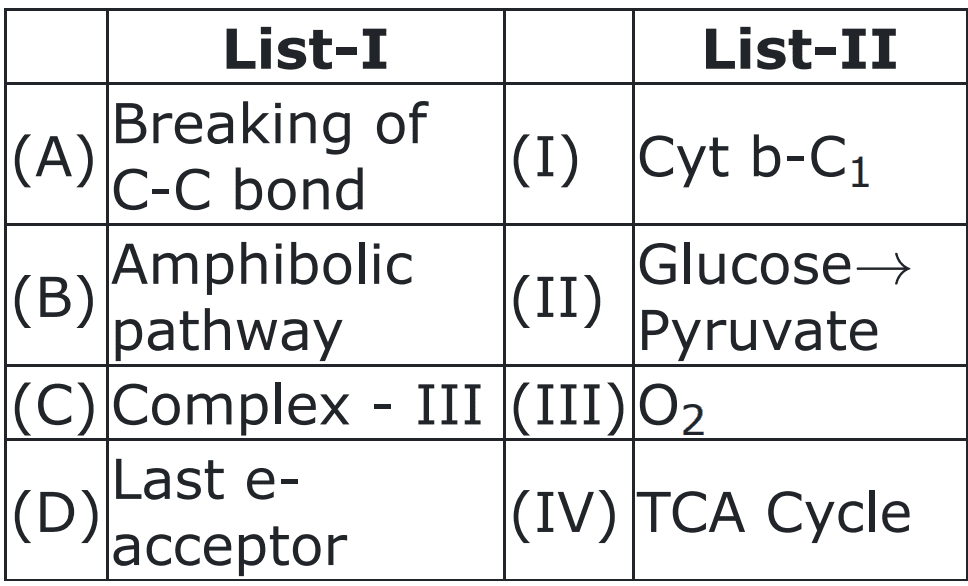
A
A-III, B-IV, C-II, D-I
B
A-II, B-I, C-IV, D-III
C
A-II, B-IV, C-I, D-III
D
A-IV, B-II, C-III, D-I
Explanation
Class 11th NCERT Page No.227, 233, 235 In cellular respiration, the breaking of the C–C bond takes place during glycolysis, where glucose is broken down into pyruvate, so it matches with Glucose → Pyruvate (II). The TCA cycle is considered an amphibolic pathway because it plays both catabolic (breaking down molecules for energy) and anabolic (providing precursors for biosynthesis) roles, hence it matches with (IV). In the electron transport chain, Complex III is represented by the cytochrome b–c1 complex, so it matches with (I). Finally, the last electron acceptor in aerobic respiration is oxygen (O2), which matches with (III).
Previous
Considering both substrate level phosphorylation, and oxidative phosphorylation
NextMatch the columns:
More from Respiration (Cellular)
Medium
Respiratory quotient (RQ) value of Tripalmitin (C51H98O6) is?
MediumNADH is oxidised to NAD+ in fermentation, however the reaction is very .....A..... in case of aerobi
MediumStudy the given figure and find the number of H+ moving through ATP synthase for 1 ATP formation dur
MediumIn anaerobic respiration :-
EasyMatch the columns:
MediumConsidering both substrate level phosphorylation, and oxidative phosphorylation of NADH + H⁺ and FAD
Practice Zoology Exams
Full-length mock tests with detailed analytics, rank, and percentile.
Browse Exams