JEE Advanced Syllabus 2027 (Physics, Chemistry & Mathematics)
Check the complete JEE Advanced 2027 syllabus for Physics, Chemistry, and Mathematics. Explore subject-wise topics, important chapters, and IIT JEE preparation resources.
JEE Advanced Syllabus 2027
The JEE Advanced syllabus forms the foundation of preparation for admission into the Indian Institutes of Technology (IITs). The syllabus is based on concepts from Classes 11 and 12 but focuses on deeper conceptual understanding, analytical reasoning, and application-oriented problem solving.
Unlike many entrance examinations, JEE Advanced emphasizes multi-concept questions that test a student's ability to connect different topics and apply theoretical knowledge to unfamiliar situations. Candidates should thoroughly prepare all topics in Physics, Chemistry, and Mathematics as questions may be asked from any part of the prescribed syllabus.
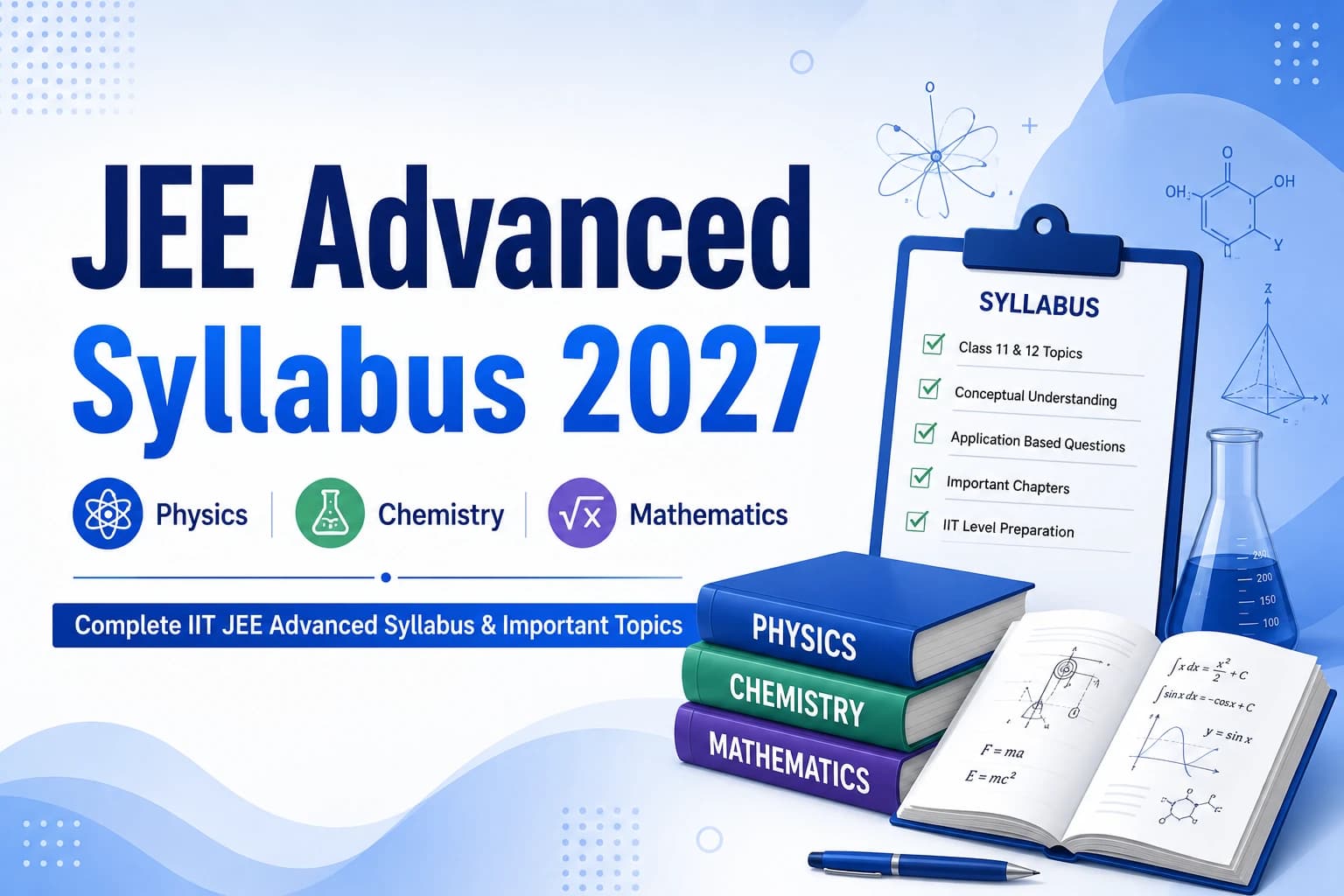
- ▸Three Subjects: Physics, Chemistry & Mathematics
- ▸Based on Class 11 & 12 Concepts
- ▸Focus on Conceptual Understanding
- ▸Application-Based Questions
- ▸Higher Difficulty than JEE Main
- ▸Questions Often Combine Multiple Topics
JEE Advanced Physics Syllabus 2027
The Physics syllabus evaluates a student's understanding of fundamental principles and their ability to apply concepts in practical and theoretical situations.
Major topics included in Physics are:
General Physics
Units and dimensions, error analysis, significant figures, vectors, measurements and experimental methods.
Mechanics
Kinematics, Newton's laws of motion, friction, circular motion, work, energy and power, center of mass, momentum, collisions, rotational dynamics, gravitation and fluid mechanics.
Thermal Physics
Thermal expansion, calorimetry, kinetic theory of gases, heat transfer, thermodynamic processes, laws of thermodynamics and entropy.
Oscillations and Waves
Simple harmonic motion, damped oscillations, wave motion, sound waves, resonance, Doppler effect and standing waves.
Electricity and Magnetism
Electrostatics, capacitors, electric current, magnetic effects of current, electromagnetic induction, alternating current and electromagnetic waves.
Optics
Geometrical optics, reflection, refraction, mirrors, lenses, optical instruments, interference, diffraction and polarization.
Modern Physics
Photoelectric effect, dual nature of matter, atomic structure, nuclear physics, radioactivity and semiconductor devices.
JEE Advanced Chemistry Syllabus 2027
The Chemistry syllabus is divided into Physical Chemistry, Inorganic Chemistry, and Organic Chemistry. Questions often require conceptual clarity as well as numerical and reaction-based problem-solving abilities.
Physical Chemistry
Important topics include:
Mole concept, atomic structure, gaseous state, chemical thermodynamics, chemical equilibrium, ionic equilibrium, electrochemistry, chemical kinetics, solutions, solid state and surface chemistry.
Inorganic Chemistry
Important topics include:
Periodic table, chemical bonding, coordination compounds, hydrogen, s-block elements, p-block elements, d-block elements, f-block elements, metallurgy, qualitative analysis and environmental chemistry.
Organic Chemistry
Important topics include:
General organic chemistry, resonance, inductive effects, reaction intermediates, stereochemistry, hydrocarbons, alkyl halides, alcohols, ethers, aldehydes, ketones, carboxylic acids, amines, biomolecules, polymers and practical organic chemistry.
Special emphasis is generally placed on reaction mechanisms and conversion-based questions.
JEE Advanced Mathematics Syllabus 2027
The Mathematics syllabus focuses on analytical thinking, logical reasoning and advanced problem-solving skills.
Major topics included are:
Algebra
Sets, relations and functions, complex numbers, quadratic equations, permutations and combinations, mathematical induction, binomial theorem, sequences and series, matrices and determinants.
Trigonometry
Trigonometric functions, identities, inverse trigonometric functions, equations and properties of triangles.
Analytical Geometry
Straight lines, circles, parabola, ellipse, hyperbola and coordinate geometry applications.
Differential Calculus
Limits, continuity, differentiability, derivatives and applications of derivatives.
Integral Calculus
Indefinite integration, definite integration, differential equations and area under curves.
Vector Algebra and Three-Dimensional Geometry
Vectors, dot product, cross product, lines, planes and spatial geometry.
Probability and Statistics
Probability distributions, conditional probability, Bayes' theorem, mean, variance and standard deviation.
Most Important Chapters for JEE Advanced
Although every topic is important, certain chapters consistently contribute a significant number of questions.
Physics
Mechanics, Electrodynamics, Modern Physics, Thermodynamics, Optics and Waves.
Chemistry
Chemical Bonding, Coordination Compounds, Organic Reaction Mechanisms, Thermodynamics, Electrochemistry and Chemical Equilibrium.
Mathematics
Calculus, Coordinate Geometry, Algebra, Probability, Vectors and Three-Dimensional Geometry.
Students targeting top IIT ranks should develop strong command over these high-weightage areas while ensuring complete syllabus coverage.
- ▸Complete the entire syllabus first.
- ▸Previous Year Papers
- ▸Chapter-wise Practice Questions
- ▸Full-Length Mock Tests
- ▸Advanced-Level Numerical Problems
- ▸Mixed Concept Questions
How JEE Advanced Syllabus Differs from JEE Main
While the syllabus of JEE Main and JEE Advanced overlaps significantly, the depth of questions is considerably different.
JEE Main generally focuses on direct application of concepts and formulas, whereas JEE Advanced emphasizes conceptual depth, analytical reasoning and multi-step problem solving. Questions in JEE Advanced often combine two or more chapters and require deeper understanding rather than straightforward formula application.
Therefore, students preparing for JEE Advanced should not only complete the syllabus but also learn to connect concepts across different topics.