The acceleration-time graph of a particle moving in straight line is shown. If initial velocity of the particle is 6 m/s, then velocity at the end of 4 second will be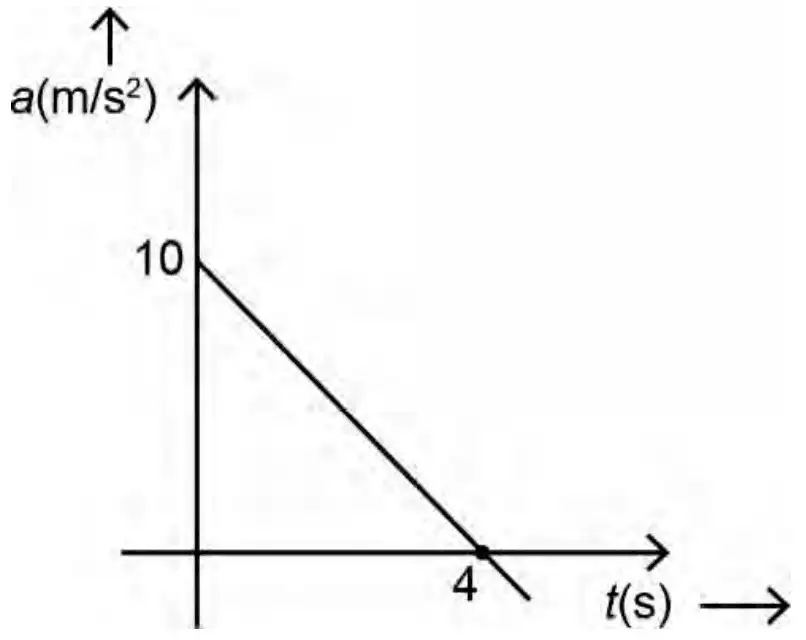
Area under a–t graph gives change in velocity.
From the graph, Area = Change in velocity
vf – vi = × (4) × (10)
vf = 20 + 6 = 26 m/s
A block of mass 0.1 kg is pressed against a wall with a horizontal force of 5 N
NextTwo particles of masses m and 4m are moving in horizontal circles. The heavier m
A steel rod of length 25 cm has a cross-sectional area of 0.8 cm². The force required to stretch thi
MediumFigure shows three forces applied to trunk that moves leftward by 3m over a smooth floor. The force
MediumA body moves along a horizontal circular path of radius 5 m. The coefficient of friction between the
MediumA block slides down a frictionless incline making an angle θ with the floor at an elevator. The elev
EasyThe maximum velocity (in ms⁻¹) with which a car driver can traverse a flat curve of radius 150 m and
MediumTwo blocks of masses 2m and m are in equilibrium as shown in the figure. Now the string between the
Practice Physics Exams
Full-length mock tests with detailed analytics, rank, and percentile.
Browse Exams