Plant Kingdom
69 questions · Click an option and press Check Answer to reveal the result
The following figures respectively represent
Laminaria, Fucus and Dictyota
Fucus, Laminaria and Dictyota
Dictyota, Laminaria and Fucus
Fucus, Dictyota and Laminaria
Match the column :
| Column I | Column II |
|---|---|
AChlamydomonas | iIsogamous |
BVolvox | iiAnisogamous |
CFucus | iiiOogamous |
DSpirogyra | iv. |
Identify A, B, C and D in the table given below.
A-Chlorophyll a, c, fucoxanthin, B-Floridian starch, C-Cellulose, D-Absent
Observe the following figure and select correct option.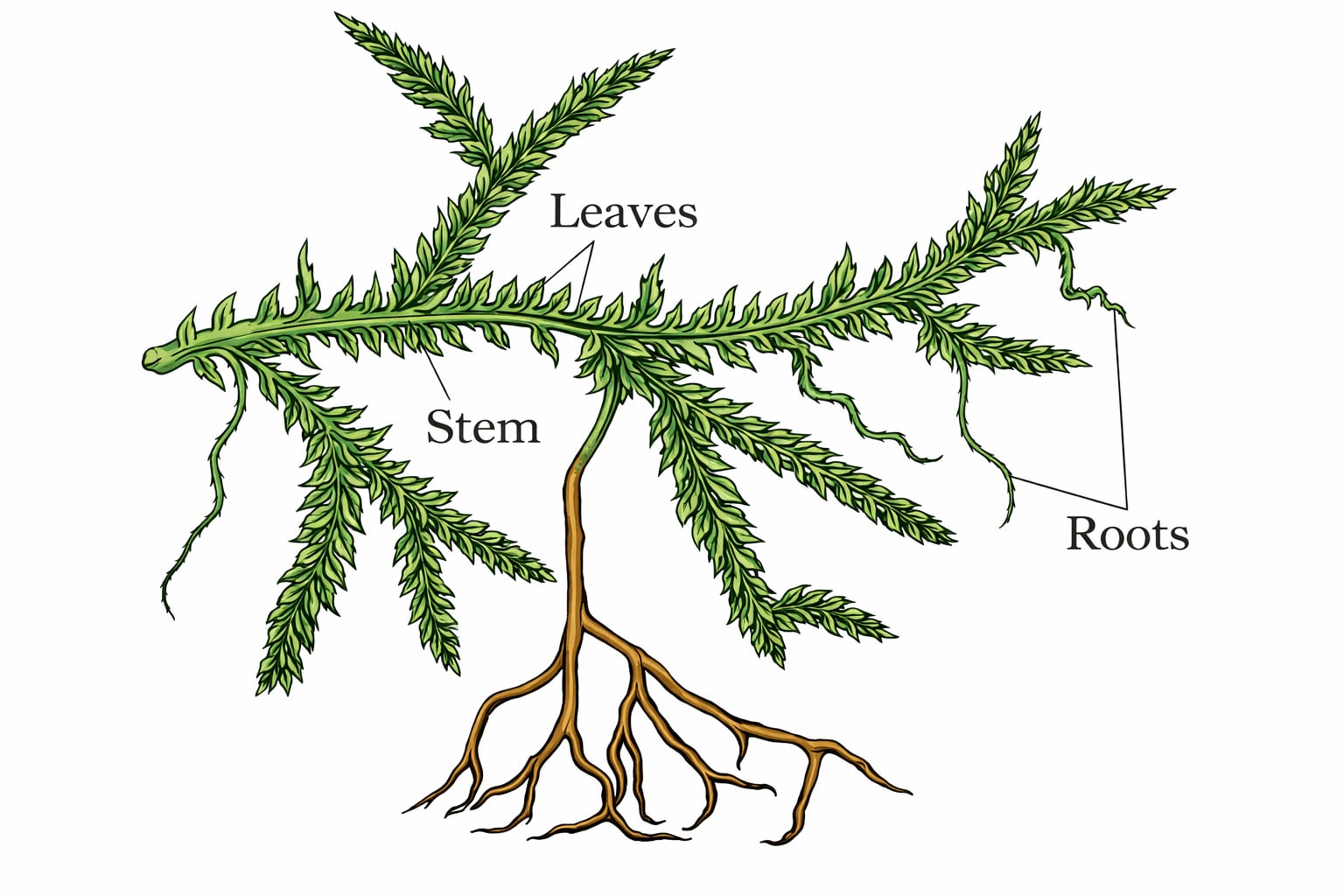
It represents Sphagnum belonging to Mosses
It represents Selaginella belonging to Mosses
It represents Selaginella belonging to Lycopsida
It represents Sphagnum belonging to Lycopsida
Assertion : In member of red algae, oogamous type of sexual reproduction is found.
Reason : In life cycle of red algae motile structure is absent.
The figure given below represents
Haplontic life cycle as seen in Volvox
Diplontic life cycle as seen in gymnosperms &
angiosperms.
Haplo-diplontic life cycle as seen in Bryophytes &
Pteridophytes
Haplo-diplontic life cycle as seen in gymnosperms
& angiosperms
Fill in the blanks correctly w.r.t. the life cycle of a moss :
A moss of sporophyte → A → Spore mother cell → B → Spore → C → Leafy gametophyte
Few stages of life cycle of moss is given below. Arrange these events in correct order starting from sex organ bearing structure and select the correct option from given below :
A. Protonema
B. Leafy gametophyte
C. Spore formation
D. Sporogonium
E. Fertilization
F. Sporophyte
A diagram of female thallus of a bryophyte is given below. Select the option giving incorrect information regarding it : 
Which of the following statements regarding the reproductive structures of Gymnosperms is correct?
The male and female cones are always borne on the same tree in all gymnosperms.
Pollen grains are transferred by wind in most gymnosperms.
Double fertilization occurs within the naked ovule.
The endosperm is formed after fertilization and is diploid (2n).
Match List-I with List-II.
Choose the most appropriate answer from the options given below.
| List-I (Organism) | List-II (Characteristic) |
|---|---|
A Chara | i Oogamous sexual reproduction, chloroplasts contain chlorophyll a and d |
B Anabaena | ii Stored food is laminarin or mannitol, chloroplasts contain chlorophyll a and c |
C Polysiphonia | iii Chloroplasts contain pyrenoids, chlorophyll a and b |
D Dictyota | iv Chloroplasts are not present, can fix atmospheric nitrogen in specialised cells |
Recognise the figure and choose the correct option:
Given below are the stages in the life cycle of pteridophytes. Arrange the following stages in the correct sequence.
A. Prothallus stage
B. Meiosis in spore mother cells
C. Fertilisation
D. Formation of archegonia and antheridia in gametophyte.
E. Transfer of antherozoids to the archegonia in presence of water.
Choose the correct answer from the options given below:
B, A, D, E, C
B, A, E, C, D
D, E, C, A, B
E, D, C, B, A
Given below are stages in the life cycle of a moss (bryophyte). Arrange the following stages in the correct chronological sequence starting from spore germination.
A. Formation of leafy gametophyte from protonema.
B. Germination of spores to form creeping green protonema.
C. Meiosis in the capsule of the sporophyte.
D. Development of sporophyte (foot, seta, capsule) from zygote.
E. Fertilization in the presence of water to form zygote.
Choose the correct answer from the options given below:
C, B, E, D, A
B, A, E, D, C
B, A, D, E, C
C, E, D, A, B
Identify the figures given below
Polysiphonia & Porphyra respectively
Porphyra & Polysiphonia respectively
Polysiphonia & Gracilaria respectively
Gracilaria & Porphyra respectively
Which is correctly labelled?
A= Antheridiophore B= Gemma cup C= Rhizoids
A= Archegoniophore B= Gemma cup C= Rhizoids
A= Gemma cup B= Archegoniophore C= Rhizoids
A= Gemma cup B= Antheridiophore C= Rhizoids
The following figures respectively represent: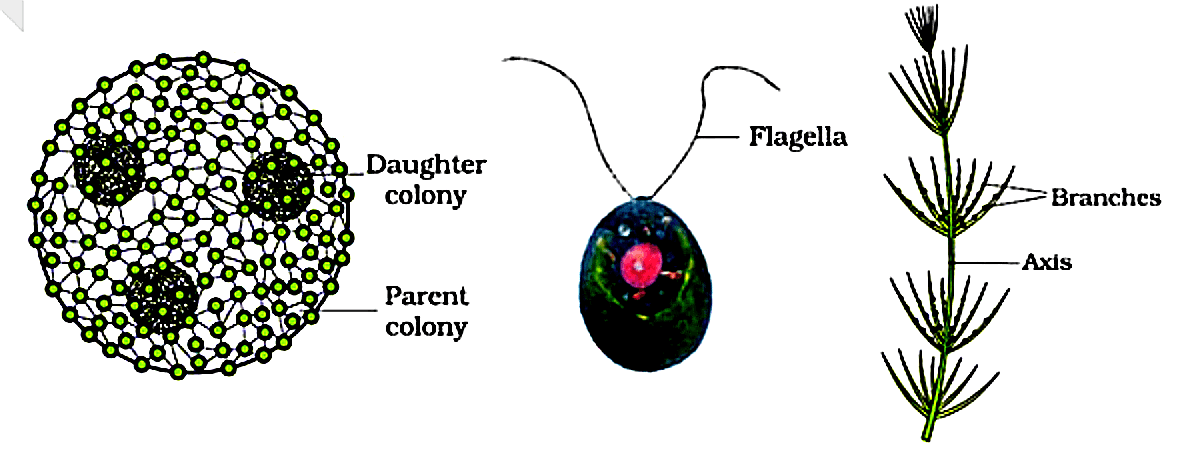
Chlamydomonas, Volvox, Chara
Chara, Volvox, Chlamydomonas
Volvox, Chlamydomonas, Chara
Volvox, Chara, Chlamydomonas
Choose the correct option that accurately matches the type of root system with the respective gymnosperm:
List-I (Root System) List-II (Gymnosperm)
A. Coralloid roots with N₂-fixing cyanobacteria I. Pinus
B. Tap roots associated with mycorrhizal fungi II. Ginkgo
C. Branched tap roots III. Cycas
A-III, B-I, C-II only
A-I, B-II, C-III only
A-III, B-II, C-I only
A-II, B-I, C-III only
Given below are two statements:
Statement-I : In Bryophytes, the sporophyte is not free living but attached to the photosynthetic gametophyte and derives nourishment from it.
Statement-II : In heterosporous pteridophytes the female gametophyte are retained on the parent sporophytes for variable periods. In the light of the above statements, choose the most appropriate answer from the options given below: