Organisms and Populations
67 questions · Click an option and press Check Answer to reveal the result
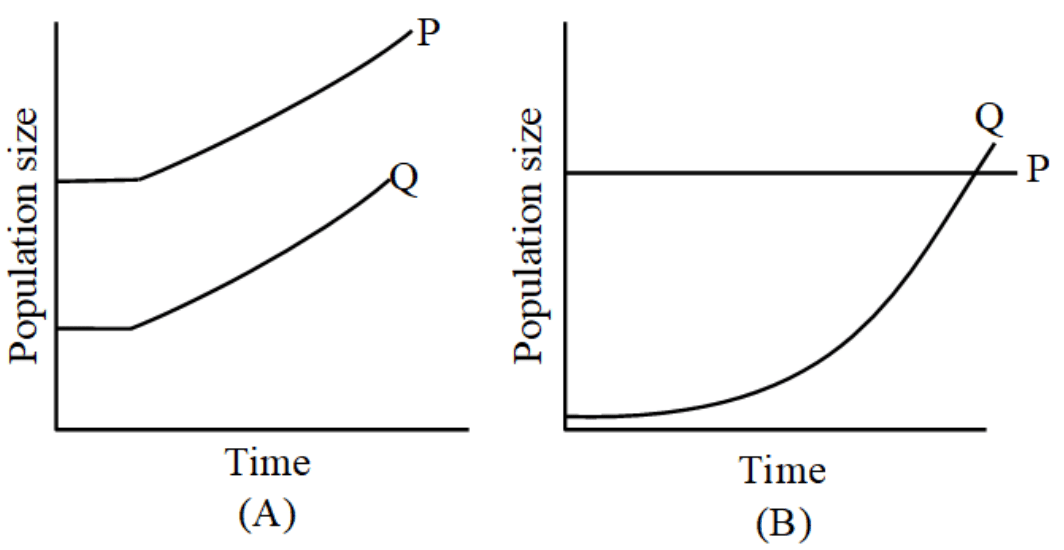
Graphs A and B shown below depict interaction of two species, Which graph indicates Mutualism ?
If the birth rate is 100, the death rate is 10 and the number of individuals in a population group is 1000, then what will be the intrinsic rate of natural increase of the population?
Match the following and Choose the correct answer
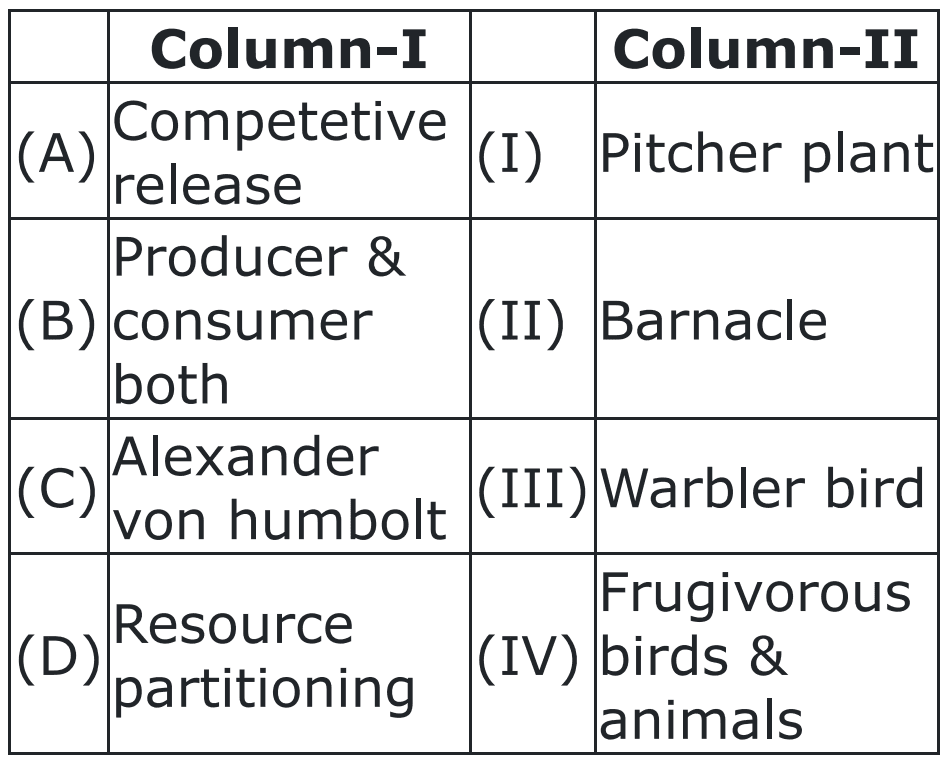
(A)-I, (B)-II, (C)-III, (D)-IV
(A)-IV, (B)-III, (C)-II, (D)-I
(A)-II, (B)-I, (C)-IV, (D)-III
(A)-III, (B)-IV, (C)-I, (D)-II
Match the columns-I and II and choose the correct options given.
| Column I | Column II |
|---|---|
ACamouflaged | iAcacia |
BDistasteful | iiCalotropis |
CThorns | iiiMonarch butterfly |
DCardiac | ivFrogs |
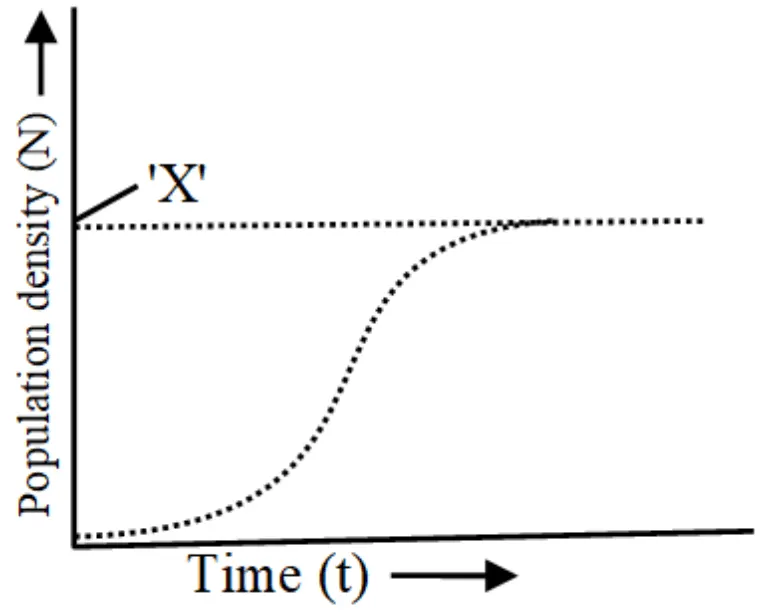
'X' in the given graph represents :
Read the following statements and select the correct option.
Statement 1 : Species facing competition might evolve mechanisms that promote exclusion rather than co-existance.
Statement 2 : Majority of parasites reduce the survival, growth and reproduction of the host and reduce its population density.
Given below are two statements:
Statement I: In an expanding population, the number of pre-reproductive individuals is more than that of reproductive and post-reproductive individuals.
Statement II: Sex ratio is a population attribute. In the light of the above statements, choose the correct answer from the options given below:
Match List-I with List-II.
List-I (Organisms) List-II (Description of interaction between them)
(A) Cuckoo laying eggs in Crow’s nest (I) One benefitted, another unaffected
(B) Orchid growing as an epiphyte on a mango branch (II) One benefitted, another harmed
(C) Fig and pollinator wasp (III) Both lose
(D) Visiting Flamingoes and resident fishes in some shallow South American lakes (IV) Both benefitted
Choose the most appropriate answer from the options given below.
Which of the interactions has negative effects ?
(i) Predation (ii) Mutualism (iii) Commensalism (iv) Parasitism