Mole Concept
107 questions · Click an option and press Check Answer to reveal the result
10 molal solution is prepared by dissolving x g of urea (Molar mass = 60 g mol–1 ) in 100 g of water. The value of x is:
60 g
30 g
120 g
180 g
6.022 × 10²¹ molecules of glucose are present in 100 mL of solution. The concentration of solution is:
N3−
N3−
O2+
O2−
The moles of O2 required for reacting with 6.8 g of ammonia is:
4NH3 + 5O2 → 4NO +6H2O
5
2.5
1
0.5
Given below are two statements:
Assertion (A): The reactant which gets consumed first, limits the amount of product formed.
Reason (R): The reactant which decides the amount of product formed is called excess reagent.
In the light of the above statements, choose the correct answer from the options given below:
A is true but R is false.
A is false but R is true.
Both A and R are true and R is the correct explanation of A.
Both A and R are true but R is NOT the correct explanation of A.
What is the mass of oxygen required for the complete combustion of 2.8 kg of ethylene?
C2H4 + 3O2 → 2CO2 + 2H2O
The number of molecules in 1 mL of CO2 at STP is;
1.12 × 10²⁰
2.16 × 10²⁰
3.12 × 10²¹
2.69 × 10¹⁹
Given below are two statements:
Statement-I: Vapour density of CH4 is half of O2.
Statement-II: 1.6 g of CH4 contains same number of electrons as 3.2 g of O2.
In the light of the above statements, choose the most appropriate answer from the options given below:
Calculate the total number of moles in 5.6 L N2.
0.5
0.75
0.25
0.05
Nitrogen and oxygen combines to form N2O5 and NO2 containing 25.92% and 30.43% of Nitrogen respectively by mass, the data illustrates;
Law of conservation of mass.
Law of constant proportions.
Law of reciprocal proportions.
Law of multiple proportions.
Percentage of water in hydrated sodium carbonate (Na2CO3·10H2O) is:
112.0 mL of NO2 at STP was liquefied, the density of the liquid being 1.15 g mL−1. Calculate the number of molecules in the liquid NO2 (At. wt. N = 14)
1.1 × 10²¹
3.1 × 10²¹
2.1 × 10¹⁵
4.1 × 10²¹
Which of the following phrases would be incorrect to use?
The mass of one ammonia (NH3) molecule is:
17 NA g
g
g
Equal masses of H2, O2 and CH4 have been taken in a container of volume V at temperature 27°C in identical conditions. The ratio of the volumes of gases H2 : O2 : CH4 would be;
An element Z contains two naturally occurring isotopes 17Z35 and 17Z37. If the average atomic mass is 35.5 u, then the percentage of two isotopes 17Z35 and 17Z37 repectively is:
The number of ions present in 2 L of a solution of 1.6 M Al2(SO4)3 is:
4.8 × 10²²
4.8 × 10²³
9.6 × 1024
9.6 × 10²²
Match List I with List II A.
| List I | List II |
|---|---|
A Vapour density | i 2NA atoms |
B 1 mole | ii 0.5 mole electrons |
C 24 g carbon | iii Collection of NA particles |
D 3.01 × 10²³ | iv Molecular Mass × |
Match List I with List II
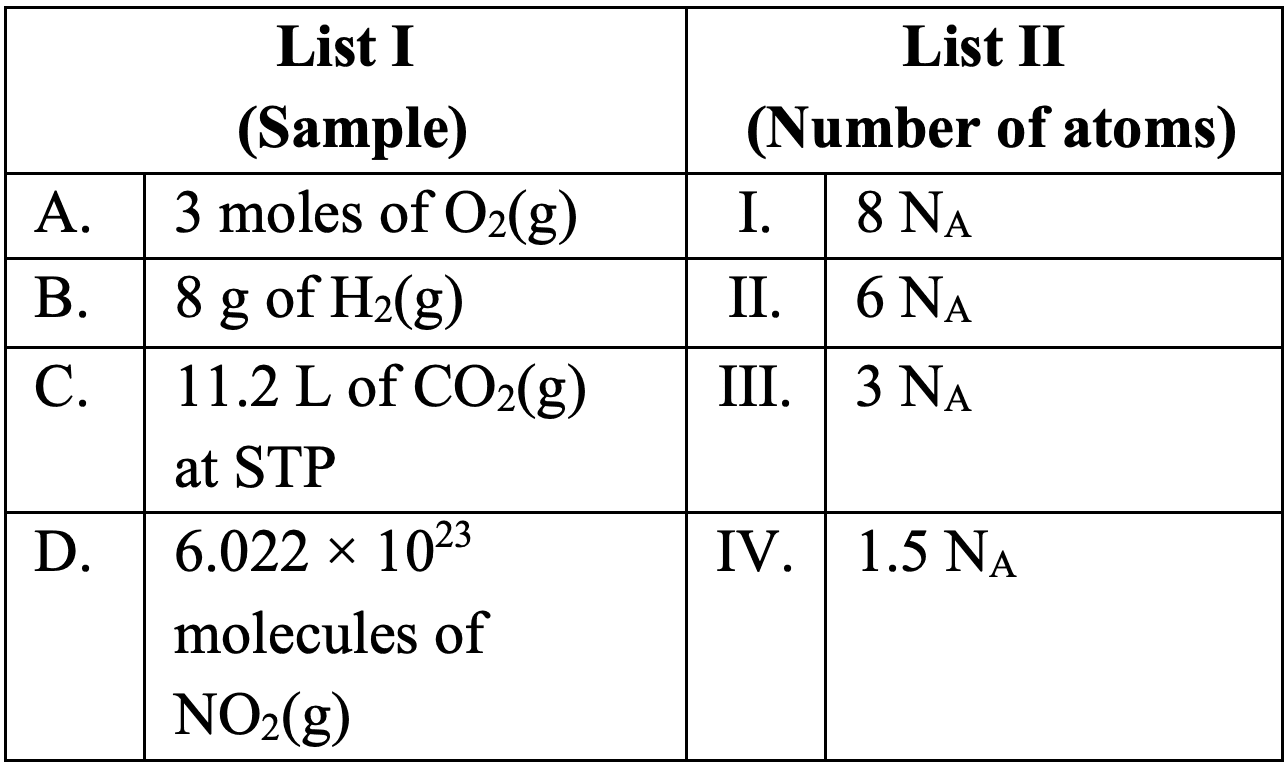
Choose the correct answer from the options given below
A-II, B-I, C-IV, D-III
A-III, B-I, C-II, D-IV
A-I, B-II, C-IV, D-III
A-IV, B-II, C-III, D-I
The amount of H2O formed by the reaction of 10 g of H2 with 64 g of O2 is:
Given below are two statements:
Statement I: The sum of mole fractions of all the components in a solution is always unity.
Statement II: One gram molecule of hydrogen contains NA atoms of hydrogen.
In the light of the above statements, choose the most appropriate answer from the options given below:
The maximum amount of BaSO4 that can be obtained on mixing 0.5 mol BaCl2 with 1 mol H2SO4 is
CH4
CH2
CH3
1.032 × 10²²
1.20 × 10²²
5.88 × 10²³
6.02 × 10²³
When 60 g of salt is dissolved in 600 mL of water, the mass by volume percentage of salt in the solution is:
The number of atoms in 20 g of SO3 is approximately -
1 × 10²³
1.5 × 10²³
2 × 10²³
6 × 10²³
The mass percentage of carbon in ethanol (C2H5OH) is:
Given below are two statements: one is labelled as Assertion (A) and other is labelled as Reason (R):
Assertion (A): 2 moles of N2 on reaction with 9 moles of H2 will produce 4 moles of NH3.
Reason (R): H2 is a limiting reagent. In the light of above statements, choose the correct answer from the options given below:
A is true but R is false
A is false but R is true
Both A and R are true and R is the correct explanation of A.
Both A and R are true and R is NOT the correct explanation of A
The number of ions present in 2 L of a solution of 1.6 M Al2(SO4)3 is; [Given: NA = 6 × 10²³ ]
4.8 × 10²²
4.8 × 10²³
9.6 × 1024
9.6 × 10²²
25.3 g of sodium carbonate, Na2CO3 is dissolved in enough water to make 250 mL of solution. If sodium carbonate dissociates completely, molar concentration of sodium ion, Na+ and carbonate ions, CO32– are respectively (Molar mass of Na2CO3 = 106 g mol–1)
O2
H2O
2.4 g of Mg is burnt with 3.2 g of O2 in a closed vessel. The amount of MgO formed is:[Atomic mass of Mg = 24 u, O = 16 u]
Mg + O2→ MgO
Common salt obtained from sea-water contains 95% NaCl by mass. The approximate number of molecules present in 10 g salt is;
1021
1022
1023
1024
x g of propane (C3H8) on combustion with 32 g of oxygen produces 26.4 g of CO2 and 14.4 g of H2O. The value of x is:
4 moles of SO2 and 6 moles of O2 react to form SO3. Total number of moles of reactant and product in the container when only 70% SO2 is used is;
5.5
8.6
10.5
6.9
Which one contains the maximum number of molecules?
2 mol of N2
41 g of dinitrogen
6.022 × 1024 molecules
5 g atom of N2
The molecular formula of a compound is C6H12O6. What’s the empirical formula?
C2H2O
C2H6O2
CH2O
92g of a compound on analysis gave 24g C, 4g H and 64g O. The empirical formula of compound is;
C2H4O2
C2H2O2
CH2O2
CH2O
How many moles of potassium chlorate to be heated to produce 11.2 litre oxygen
0.5 mol
0.33 mol
0.25 mol
0.66 mol
Given below are two statements:
Assertion (A): 2 moles of N2 on reaction with 9 moles of H2 will produce 4 moles of NH3.
Reason (R): H2 is a limiting reagent.
In the light of above statements, choose the correct answer from the options given below:
A is true but R is false.
A is false but R is true.
Both A and R are true and R is the correct explanation of A.
Both A and R are true and R is NOT the correct explanation of A.
8 litre of H2 and 6 litre of Cl2 are allowed to react to maximum possible extent. Find out the final volume of reaction mixture. Suppose P and T remains constant throughout the course of reaction
7 litre
14 litre
2 litre
None of these
PCl5(g)→ PCl3(g) + Cl2(g)
H2(g) + Cl2(g) → 2HCl(g)
2SO2(g) + O2(g) → 2SO3(g)
2KClO3(s) → 2KCl(s) + 3O2(g)
0.5 NA
0.005 NA
NA
1.6 NA
The molarity of 20% (W/W) solution of sulphuric acid is 2.55 M. The density of the solution is
1.25 g cm–3
0.125 g L–1
2.55 g cm–3
none of the above
Calculate the weight of lime (CaO) obtained by heating 200 kg of 95% pure lime stone (CaCO3).
104.4 kg
105.4 kg
212.8 kg
106.4 kg
Mass of one molecule of methane (CH4) is:
16 NA u
C2H6
CH4
C3H8
C4H10
Which of the following law states that, “a given compound always contains exactly the same proportion of elements by weight”?
0.212 × 10⁻⁶
2.12 × 10⁻⁵
2.12 × 10⁴
2.12 × 10⁵
16 g of O2
16 g of O3
32 g of O2
The molarity of solution containing 9.8 g of H2SO4 in 500 mL solution is:
0.2 M
2 M
0.5 M
5 M
Given below are two statements:
Statement I: Mass of 1 mole of oxygen gas is more than 1 mole nitrogen gas.
Statement II: 2 mole nitrogen gas occupies more volume than oxygen at STP.
In the light of the above statements, choose the correct answer from the options given below:
Both Statement I and Statement II are correct.
Statement I is correct but Statement II is incorrect.
Statement I is incorrect but Statement II is correct.
Both Statement I and Statement II are incorrect.
5.53 × 10⁻²³ g
One mole of CO2 contains:
3 g atoms of CO2
1.8 × 10²³ molecules
6.022 × 10²³ atoms of O
6.022 × 10²³ atoms of C
The moles of O2 required for reacting with 6.8 g of ammonia is:
4NH3 + 5O2 → 4NO + 6H2O
XY2
X2Y
X2Y3
XY3
x g of propane (C3H8) on combustion with 32 g of oxygen produces 26.4 g of CO2 and 14.4 g of H2O. The value of x is:
7.5 g
6.3 g
4.9
8.8 g
5.85 g NaCl is dissolved in 1 L water. The total number of Na+ and Cl– ions in 1 mL of this solution will be;
6.02 × 10¹⁹
1.2 × 10²²
1.2 × 10²⁰
6.02 × 10²⁰
atoms of different elements may combine with each other in a fixed, simple, whole number ratio to form compounds.
equal volumes of all gases under the same temperature and pressure conditions contain an equal number of atoms.
equal volumes of all gases under the same conditions of temperature and pressure contain an equal number of molecules.
gases react together in volumes which bear a simple ratio to one another.
The percentage of nitrogen in urea (NH2CONH2), is;
10-12 and 10-1
10-9 and 10-15
10-15 and 10-24
10-12 and 10-2
For a reaction,
N₂(g) + 3H₂(g) → 2NH₃(g)
Identify dihydrogen (H₂) as a limiting reagent in the following reaction mixtures:
35 g of N₂ + 8 g of H₂
The mass of 1 × 10²³ molecules of H2O is:
Given below are two statements:
Statement-I: 1g O2 and 1g O3 have equal number of atoms.
Statement-II: Mass of 1 mole of an atom is equal to its gram-atomic mass.
How much volume of oxygen will be required for complete combustion of 40 mL of acetylene (C2H2)? (All volume are measured at STP)
2C2H2 + 5O2 → 4CO2 + 2H2O
one twelfth of the mass of one carbon-14 atom.
one twelfth of the mass of one carbon-12 atom.
one sixth of the mass of one carbon-12 atom.
one twelfth of the mass of one carbon-13 atom.
20 g of metal combines with oxygen to form 60 g of metal oxide (MO). The percentage of oxygen in metal oxide is
84.3%
72.9%
33.3%
66.6%
1.66056 × 10⁻²⁴ g
1.66056 × 10⁻²⁷ g
1.66056 × 10⁻²³ g
1.66056 × 10⁻²⁶ g
H2O and D2O
SO2 and SO3
Mg(OH)2 and MgO
Given below are two statements:
Statement I: 10 ppm means 10 g solute in 106 g solution.
Statement II: 1 m NaOH means 1 mol of NaOH is present in 1000 g solution.
Naturally occurring chlorine is 75 % Cl35 and 25 % Cl37. Calculate the average atomic mass of chlorine
35.5 amu
36.5 amu
71 amu
72 amu