All Practice Exams
0 of 58 answered
Chemistry
Liquid Solutions
58 questions · Click an option and press Check Answer to reveal the result
1
In a mixture of A and B, components show negative deviation when
A
A-B interaction is stronger than A-A and B-B interaction
B
A-B interaction is weaker than A-A and B-B interaction
C
ΔVmix > 0, ΔSmix > 0
D
ΔVmix = 0, ΔSmix > 0
2
The vapour pressure of pure liquid A is 0.80 atm. When a non-volatile B is added to A its vapour pressure drops to 0.60 atm. The mole fraction of B in the solution is:
A
0.125
B
0.25
C
0.5
D
0.75
3
Which among the following solutions will exhibit positive deviation from Raoult's law?
A
n-hexane and n-heptane
B
HNO₃ and water
C
Acetone and chloroform
D
Ethanol and acetone
4
Which of the following concentration term is/are independent of temperature?
A
Molarity
B
Molarity and mole fraction
C
Mole fraction and molality
D
Molality and normality
5
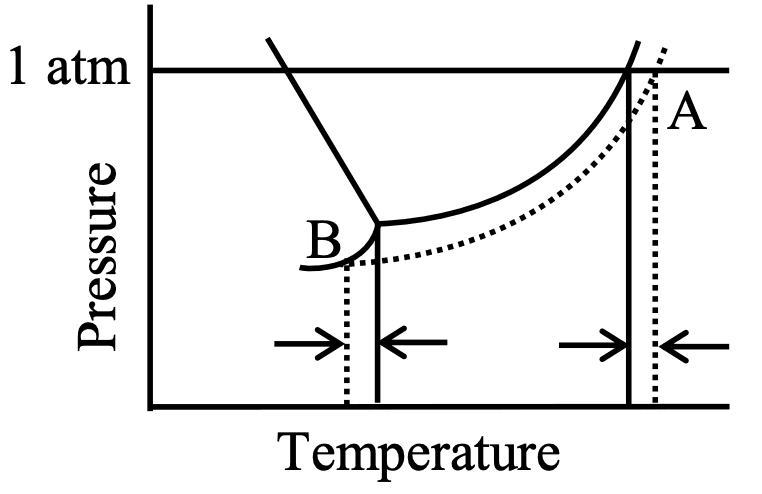
A
B
C
D
6
Which is not a colligative property in the following?
A
pH ofa buffer solution
B
Boiling point elevation
C
Freezing point depression
D
Relative vapour pressure lowering
7
The vapour pressure of two pure liquid (A) and (B) are 100 torr and 80 torr respectively. The total pressure of solution obtained by mixing 2 mole of (A) and 3 mole of (B) would be:
A
120 torr
B
36 torr
C
88 torr
D
180 torr
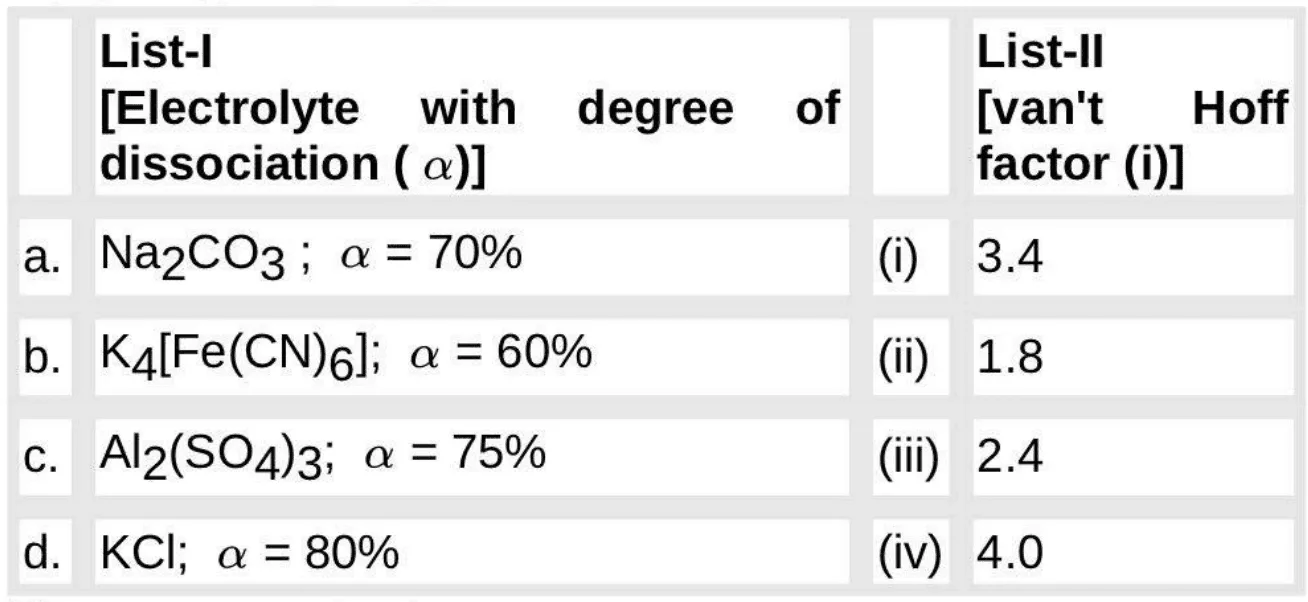
8
A
a(i), b(ii), c(iv), d(iii)
B
a(i), b(iii), c(ii), d(iv)
C
a(iii), b(ii), c(i), d(iv)
D
a(iii), b(i), c(iv), d(ii)
9
Solutions A, B, C and D are respectively 0.1M glucose, 0.05 M NaCl, 0.05 M BaCl2 and 0.1 M AlCl3. Which one of the following pairs is isotonic?
A
A and B
B
B and C
C
A and D
D
A and C
10
Freezing point of an aqueous solution is –0.186°C. Elevation of boiling point of same solution would be: (Kb = 0.512 and Kf = 1.86 K molality–1)
A
0.186°C
B
0.0512°C
C
0.092°C
D
0.237°C
11
Binary liquid solutions which exhibit negative deviations from Raoult's law boil at temperature .... than the expected value:
A
Lower
B
Higher
C
Same
D
Cannot be said
12
The normality of 2.3 MH2SO4 solution is:
A
4.6 N
B
5.6 N
C
6.6 N
D
7.6 N
13
During osmosis, flow of water through a semipermeable membrane is:
A
From both sides of semipermeable membrane with unequal flow rates
B
From solution having lower concentration of solvent only
C
From solution having higher concentration of solvent only
D
From both sides of semipermeable membrane with equal flow rates
14
The unit of molality is:
A
mol–1
B
mol kg–1
C
mol–1 L–1
D
mol L
15
Molal elevation constant of a liquid is:
A
The elevent in b.p. which would be produced by dissolving one mole of solute in 100 g of solvent
B
The elevation of b.p. which would be produced by dissolving 1 mole solute in 10 g of solvent.
C
Elevation in b.p. which would be produced by dissolving 1 mole of solute in 1000 g of solvent
D
None of the above
16
Which of the following shows maximum depression in freezing point?
A
K2SO4
B
NaCl
C
Urea
D
glucose
17
If α is the degree of dissociation of Na2SO4 the van’t Hoff factor (i) used for calculating the molecular mass is:
A
1 – 2 α
B
1 + 2 α
C
1 – α
D
1 + α
18
A
53
B
65
C
84
D
79
19
The osmatic pressure of a 5% (wt./vol) solution of cane sugar at 150°C is:
A
3.078 atm
B
4.078 atm
C
5.078 atm
D
2.45 atm
20
Which of the following associated with isotonic solutions is not correct?
A
They will have the same osmotic pressure
B
They will have the same vapour pressure
C
They have same weight concentrations
D
Osmosis does not take place when the solutions is separated by a semipermeable membrane
21
The vapour pressure (VP) of a dilute solution of non-volatile solute is P and the VP of pure solvent is P0, the lowering of the VP is:
A
+ ye
B
– ye
C
P/P0
D
P0/P
22
A
If both Assertion & Reason are True & the Reason is a correct explanation of the Assertion.
B
If both Assertion & Reason are True but Reason is not a correct explanation of the Assertion.
C
If Assertion is True but the Reason is False.
D
If both Assertion & Reason are false.
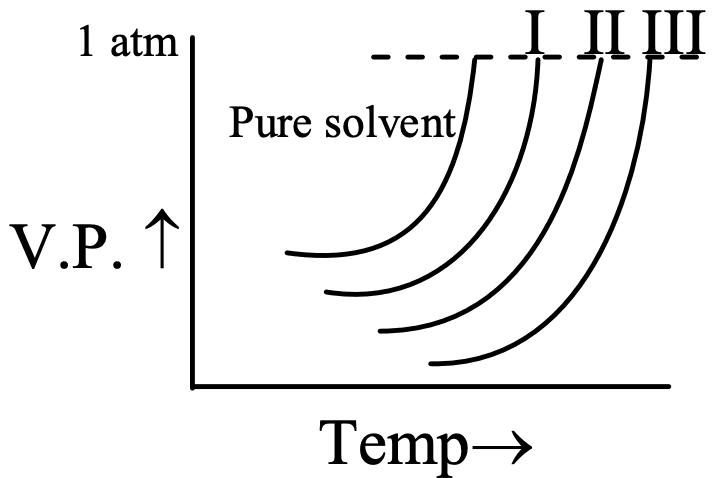
23
A
B
C
D
24
Choose the correct statement. When concentration of a salt solution is increased
A
Boiling point increases while vapour pressure decreases.
B
Boiling point decreases while vapour pressure increases.
C
Freezing point decreases while vapour pressure increases.
D
Freezing point increases while vapour pressure decreases.
25
A solution of urea (mol. mass 56) boils at 100.18°C at atmospheric pressure. If Kf and Kb for water are 1.86 and 0.512 K molality–1 respectively, the above solution will freeze at:
A
– 6.54°C
B
6.54°C
C
– 0.654°C
D
0.654°C
26
Colligative properties of a solution depends upon
A
Nature of both solvent and solute
B
Nature of solute only
C
Number of solvent particles
D
The number of solute particles
27
Saturated solution of NaCl on heating becomes:
A
Super saturated
B
Unsaturated
C
Remains saturated
D
None of these
28
If P0 and Ps are the vapour pressure of solvent and solution respectively and N1 and N2 are the mole of solute and solvent then:
A
(P0 – Ps)/P0 = N1/(N1 + N2)
B
(P0 – Ps)/Ps = N1/N2
C
Ps = P0 ⋅ N2/(N1 + N2)
D
All of the above
29
An azeotropic solution of two liquids has boiling point lower than either when it
A
Shows a negative deviation from Raoult’s law
B
Shows a positive deviation from Raoult’s law
C
Shows no deviation from Raoult’s law
D
Is saturated
30
When two liquids A and B are mixed then their boiling points becomes greater than both of them. What is the nature of this solution?
A
Ideal solution
B
Normal solution
C
Negative deviation with non-ideal solution
D
Positive deviation with non-ideal solution
31
The statement, “The mass of a gas dissolved in a given mass of a solvent at any temperature is proportional to the pressure of the gas above the solvent” is
A
Henry’s law
B
Law of mass action
C
Dalton’s law
D
None of these
32
A solution of sucrose (molar mass 342 g mol–1) has been produced by dissolving 68.5 g sucrose in 1000 g water. The freezing point of the solution obtained will be: (Kf for H2O = 1.86 K kg mol–1)
A
–0.372°C
B
0.520°C
C
+ 0.372°C
D
0.570°C
33
A and B ideal gases. The molecular weights of A and B are in the ratio of 1:4. The pressure of a gas mixture containing equal weight of A and B is p atm. What is the partial pressure (in atm) of B in the mixture?
A
p/5
B
p/2
C
p/2.5
D
3/4 p
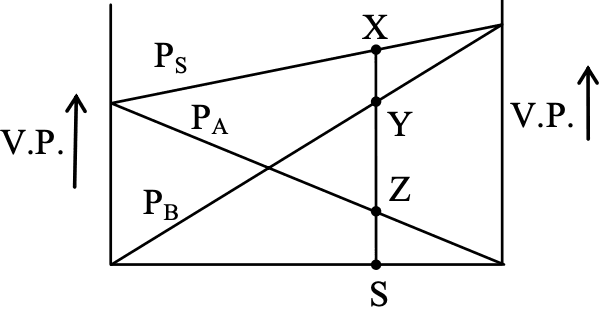
34
A
B
C
D
35
Which of the following statement is true?
A
The relative lowering of vapour pressure of a solution is equal to the mole fraction of the solute present in the solution.
B
Passage of solute molecules towards solution side through semipermeable membrane is osmosis.
C
The boiling point of solution is always lower than the solvent.
D
The boiling point of a liquid is the temperature at which its vapour pressure becomes equal to 260 mm.
36
The osmotic pressure of 0.2molar solution of urea at 27°C (R = 0.082 L atm mol–1 K–1) is
A
4.92 atm
B
1 atm
C
0.2 atm
D
27 atm
37
The freezing point of solvent is depressed by 0.37°C in a 0.01 mol NaCl solution. The freezing point of 0.02 molal solution of urea is depressed by:
A
0.37°C
B
0.74°C
C
0.185°C
D
0°C
38
The vapour pressure of benzene at a certain temperature is 640 mm of Hg. A non-volatile and nonelectrolyte solid weighing 2.175 g is added to 39.08 g of benzene. If the xapour pressure of the solution is 600 mm of Hg, what is the molecular weight of solid substance?
A
49.50
B
59.60
C
69.60
D
79.82
39
Dissolution of a solute is an exothermic process if:
A
Hydration energy > lattice energy
B
C
Hydration energy = lattice energy
D
None of the above
40
The relative lowering of vapour pressure of an aqueous solution containing non-volatile solute is 0.0125. The molality of the solution is:
A
0.70
B
0.50
C
0.60
D
0.80
41
A
B
C
D
42
The vapour pressure of benzene at 80°C is lowered by 10 mm by dissolving 2g of a non-volatile substance in 78 g of benzene. The vapour pressure of pure benzene at 80°C is 750 mm. The molecular weight of the substance will be:
A
15
B
150
C
1500
D
148
43
The solubility order for the following gases is:
A
NH3 > CO2 > O2 > H2
B
H2 > O2 > NH3 > CO2
C
CO2 > NH3 > O2 > N2
D
O2 > H2 > NH3 > CO2
44
A solution containing 1.8 g of a compound (empirical formula CH2O) in 40 g of water is observed to freeze at –0.465°C. The molecular formula of the compound is (Kf of water – =1.86 kg K mol–1)
A
C2H4O2
B
C3H6O3
C
C4H8O4
D
C6H12O6
45
Mole fraction of solute in benzene is 0.2 then find molality of solute
A
3.2
B
2
C
4
D
3.6
46
When 10 g of a non-volatile solute is dissolved in 100 g of benzene, it raises boiling point by 1°C then molecular mass of the solute is (kb for C6 H6 = 2.53 kg–mol–1)
A
223 g
B
233 g
C
243 g
D
253 g
47
Van’t hoff factor of Ca(NO3)2 is:
A
One
B
Two
C
Three
D
Four
48
The relationship between osmotic pressure at 273 K when 10 g glucose (p1), 10 g urea (p2) and 10 g sucrose (p3) are dissolved in 250 mL of water is:
A
p1 > p2 > p3
B
p3 > p2 > p1
C
p2 > p1 > p3
D
p2 > p3 > p1
49
Which of the following is incorrect?
A
Relative lowering of vapour pressure is dependent on solute mole
B
Vapour pressure of a solution is lower than the vapour pressure of the solvent
C
The vapour pressure is a colligative property
D
The relative lowering of vapour pressure is directly proportional to the mole fraction solute
50
The degree of dissociation (α) of a weak electrolyte, AxBy is related to van’t Hoff factor (i) by the expression
A
(i–1)/(x+y–1)
B
(i–1)/(x+y+1)
C
(x+y–1)/(i–1)
D
(x+y+1)/(i–1)
51
Y g of non-volatile organic substance of molecular mass M is dissolved in 250 g benzene. Molal elevation constant of benzene of Kb. Elevation in its boiling point is given by:
A
KbY/M
B
4KbY/M
C
KbY/4M
D
KYb/M
52
At high altitude the boiling of water occurs at low temp. because:
A
Atmospheric pressure is low
B
Temperature is low
C
Atmospheric pressure is high
D
None of the above
53
The vant's Hoff factor for 0.1 Mba (NO3)2 solution is 2.74. The degree of dissociation is:
A
91.3%
B
87%
C
100%
D
74%
54
Which of the following mixture does not show positive deviation from the Raoult's law?
A
Benzene + acetone
B
Acetone + ethanol
C
Acetone + chloroform
D
Water + ethanol
55
The vapour pressure of two liquids X and Y are 80 and 60 Torr respectively. The total vapour pressure of the ideal solution obtained by mixing 3 moles of X and 2 moles of Y would be:
A
68 Torr
B
140 Torr
C
48 Torr
D
72 Torr
56
Which characterises the weak intermolecular forces of attraction in a liquid?
A
High boiling point
B
High vapour pressure
C
High critical temperature
D
High heat of vaporization
57
Which one of the following aqueous solutions will exhibit highest boiling point?
A
0.01 M Na2SO4
B
0.01 M KNO3
C
0.015 M urea
D
0.015 M glucose
58
What is the freezing point of a solution containing 8.1 g HBr in 100 g water assuming the acid to be 90% ionised? (kf for wt. = 1.86 K mol–1)
A
0.85°C
B
– 3.53°C
C
+ 3.53°C
D
– 0.35°C