Excretory Products and their Elimination
46 questions · Click an option and press Check Answer to reveal the result
In the diagram showing the exchange of gases at the alveolus and the body tissues with blood and transport of carbon dioxide and oxygen, what does the pO₂ and pCO₂ (in mm Hg) represent in blood vessel marked as B?
Which of the following sequences is correct to initiate inspiration ?
I. Intrapulmonary pressure decreases
II. Diaphragm contracts
III. Air rushes into lungs
IV. Volume of thorax increases in the anterior-posterior axis.
Assertion : Exchange part is the site of actual diffusion of O₂ and CO₂ between blood and atmospheric air.
Reason : The alveoli (vascularised bag like structure) and their ducts form the exchange part. Alveoli are the primary sites of exchange of gases.
The figure given below shows a small part of human lung where exchange of gas takes place. In which one of the options given below, the one part A, B, C or D is correctly identified along with its function.
A – alveolar cavity: Main site of exchange of
respiratory gases
D – capillary wall: Exchange of gases takes
place here
B – red blood cell: Transport of mainly
haemoglobin
C – arterial capillary: Passes oxygen to tissues
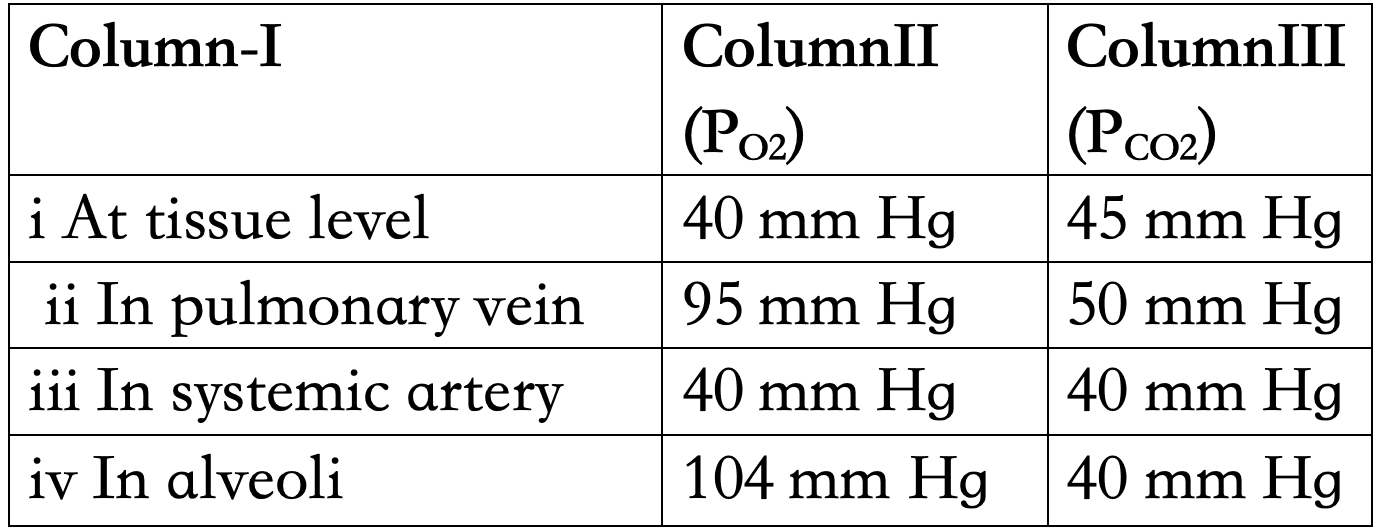
Find out the correct match from the following table:-
Given below are two statements :-
Statement-I : Mechanisms of breathing vary among different groups of animals depending mainly on their habitats and level of organisation.
Statement-II : The process of exchange of O2 from the atmosphere with CO2 produced by the cells is called breathing. In the light of the above statements,
choose the most appropriate answer from the options given below :
Statement-I : During each cardiac cycle two prominent sounds are produced which can be easily heard through a spirometer.
Statement-II : The first heart sound (lub) is associated with the closure of the tricuspid and bicuspid valves whereas the second sound (dub) is associated with the closure of the semilunar valves.
Match the Following:
(a) Asthma 1. Inflammation of nasal tract
(b) Bronchitis 2. Spasm of tracheal muscle/Bronchioles
(c) Rhinitis 3. Fully blown out/Damaged alveoli
(d) Emphysema 4. Inflammation of bronchi