Electrochemistry
176 questions · Click an option and press Check Answer to reveal the result
E°cell = 0, ΔG° = 0
Ecell = 0, ΔG = 0
For the reactions
MnO₄⁻ + 8H⁺ + 5e⁻ → Mn²⁺ + 4H₂O ; E° = 1.51 V
MnO₂ + 4H⁺ + 2e⁻ → Mn²⁺ + 2H₂O ; E° = 1.23 V
then for the reaction MnO₄⁻ + 4H⁺ + 3e⁻ → MnO₂ + 2H₂O, E° is -
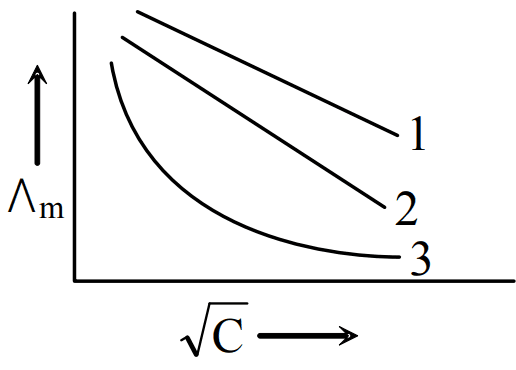
A graph of molar conductivity of three electrolytes (NaCl, HCl and NH₄OH) is plotted against √C. Which option is correct?
The standard reduction potential E° for OCl⁻/Cl⁻ = 0.86 V and Cl⁻/½Cl₂ = −1.10 V
The E° value of OCl⁻/½Cl₂ will be-
The charge required to deposit 40.5 g of Al (atomic mass = 27.0 g) from the fused Al2(SO4)3 is
4.34 × 10⁵ C
43.4 × 10⁵ C
1.44 × 10⁵ C
None of these
E°Al³⁺/Al = −1.66 V and Ksp of Al(OH)₃ = 1 × 10⁻³³.
Reduction potential of the couple at pH = 14 is-
For I₂ + 2e⁻ → 2I⁻ E°red = +0.54 V
and 2Br⁻ → Br₂ + 2e⁻ E°ox = +1.09 V
For Fe → Fe²⁺ + 2e⁻ E°ox = +0.44 V
Which reaction is non-spontaneous?
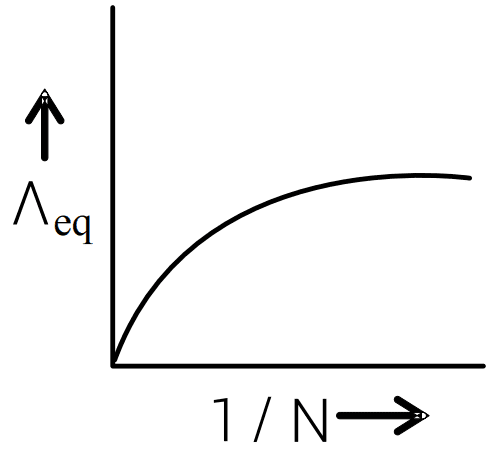
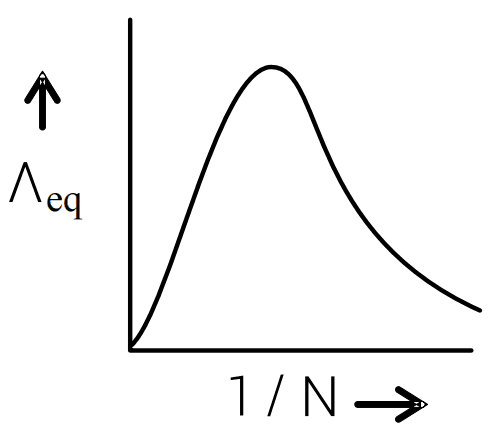
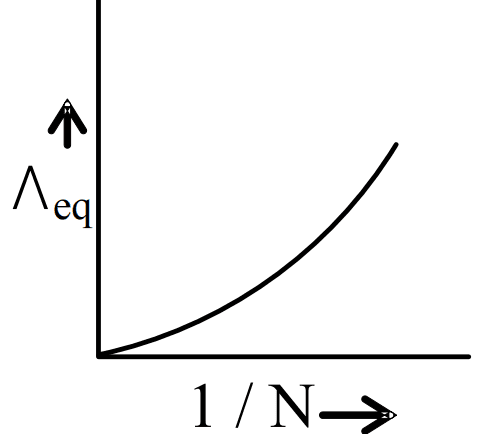
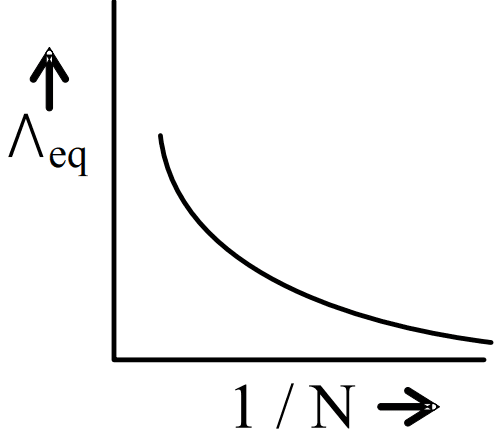
The equivalent conductivities at infinite dilution of the cation and the anion of a salt A2B are 140 and 80 ohm–1 cm2 eq-1 respectively. The equivalent conductivity (in ohm–1 cm2 eq–1) of the salt at infinite dilution is-
160
220
60
360
In the given arrangement, on pressing the key, the-
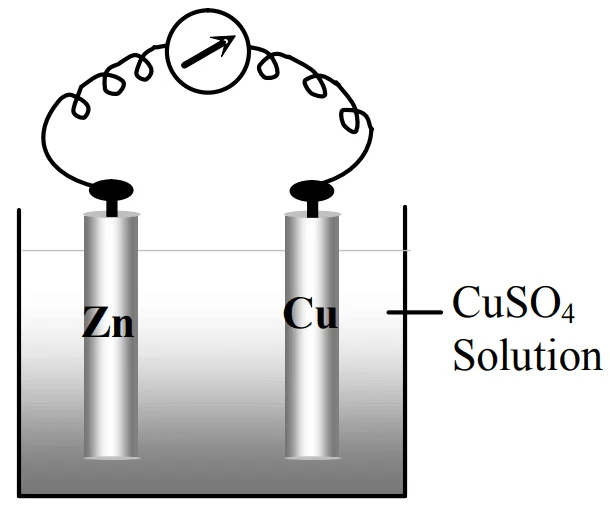
The single electrode potential E of 0.1 M solution of M⁺ ions [E°R = −2.36 V] is -
A solution containing one mol per litre each of Cu(NO3)2, AgNO3, Hg2(NO3)2 and MgSO4 is being electrolysed by using inert electrodes.The standard electrode potentials (reduction potentials) are: Ag⁺/Ag = +0.80 V Hg₂²⁺/Hg = +0.79 V Cu²⁺/Cu = +0.34 V Mg²⁺/Mg = −2.37 V With increasing voltage, the sequence of deposition of metals on the cathode will be-
Standard electrode potentials of
Fe²⁺ + 2e⁻ → Fe ; E° = −0.440 V
Fe³⁺ + 3e⁻ → Fe ; E° = −0.036 V
The standard electrode potential (E°) for Fe³⁺ + e⁻ → Fe²⁺ is -
The reaction ½H₂(g) + AgCl(s) → H⁺(aq) + Cl⁻(aq) + Ag(s)
can be represented in the galvanic cell as-
For the cell prepared from electrodes A and B
A : Cr₂O₇²⁻ / Cr³⁺ ; E°red = +1.33 V
B : Fe³⁺ / Fe²⁺ ; E°red = +0.77 V
Which statement(s) is/are correct-
The standard EMF of the cell reaction
is 1.02 V. The value of ∆0G° will be
0
– 98.43 kJ
– 196.86 kJ
– 98.43 J
The e.m.f. of the cell involving the reaction
2Ag⁺ + H₂ → 2Ag + 2H⁺ is 0.80 V.
The standard oxidation potential of silver electrode is-
When copper sulphate solution is electrolysed in a copper voltameter for 30 s, m gram of copper was deposited. Time-current graph is given. The electrochemical equivalent of copper from above plot will be-
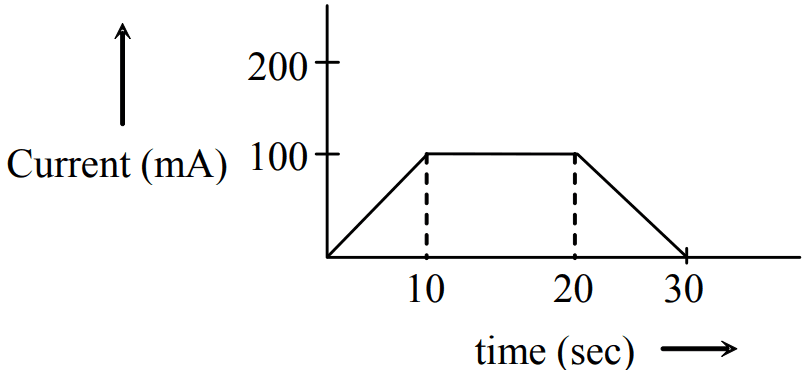
The reduction potential of the two half cell reactions are
PbSO₄ + 2e⁻ → Pb + SO₄²⁻ E° = –0.31 V
Ag⁺ + e⁻ → Ag E° = +0.80 V The feasible reaction will be-
The standard reduction potential of Pb and Zn electrodes are –0.126 V and –0.763 V respectively. The e.m.f. of the cell
Zn | Zn²⁺(0.1 M) || Pb²⁺(1 M) | Pb is-
At 298 K, the standard reduction potentials are:
Zn²⁺/Zn = −0.762 V
Cr³⁺/Cr = −0.740 V
2H⁺/H₂ = 0.00 V
Fe³⁺/Fe²⁺ = +0.770 V
The strongest reducing agent is-
At 25°C molar conductance of 0.1 molar aqueous solution of ammonium hydroxide is 9.54 ohm–1 cm2 mol–1 and at infinite dilution its molar conductance is 238 ohm–1 cm2 mol–1. The degree of ionization of ammonium hydroxide at the same concentration and temperature is :
6.6 L O₂ at STP will be formed
Match List-I with List-II
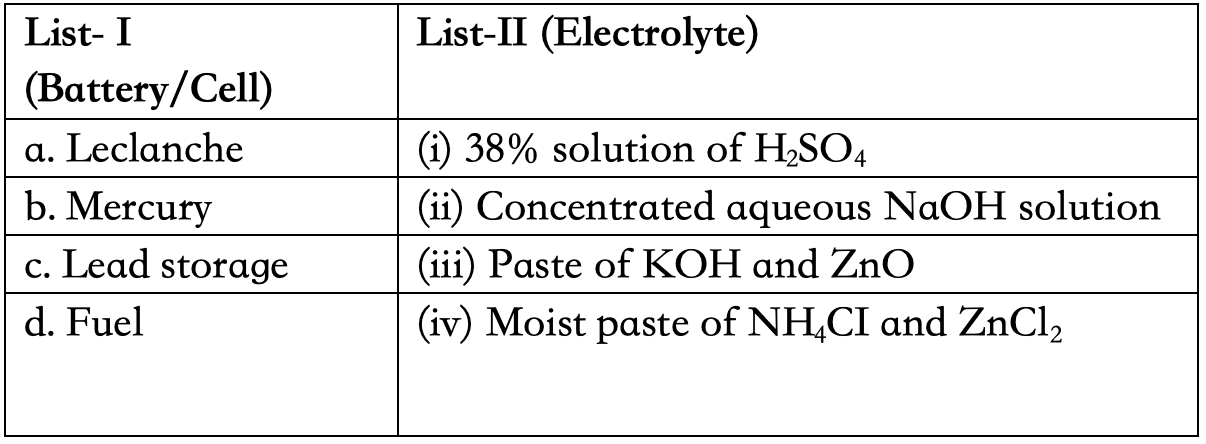
The correct option is
The standard oxidation potentials are:
Zn → Zn²⁺ + 2e⁻ ; E° = 0.76 V
Fe → Fe²⁺ + 2e⁻ ; E° = 0.41 V
The emf for the reaction Fe²⁺ + Zn → Zn²⁺ + Fe is-
Consider the following electrolytes:
1. AgNO₃ 2. CuSO₄ 3. AlCl₃ 4. Bi₂(SO₄)₃
The quantity of electricity needed to electrolyse separately 1 M solutions of these electrolytes will be-
4.5 g of aluminium (at. mass 27 amu) is deposited at cathode from Al3+ solution by a certain quantity of electric charge. The volume of hydrogen produced at STP from H+ ions in solution by the same quantity of electric charge will be:
The reaction for the cell,
Zn | Zn²⁺(1.0 M) || Cd²⁺(1.0 M) | Cd is-
Consider a voltaic cell based on these half-cells
Ag⁺ + e⁻ → Ag ; E° = +0.80 V
Cd²⁺ + 2e⁻ → Cd ; E° = −0.40 V
Identify the anode and give the voltage of the cell under standard conditions -
For a reaction A(s) + 2B⁺ → A²⁺ + 2B
KC has been found to be 10¹². The E°cell is-
In the arrangement shown, the arrow represents-
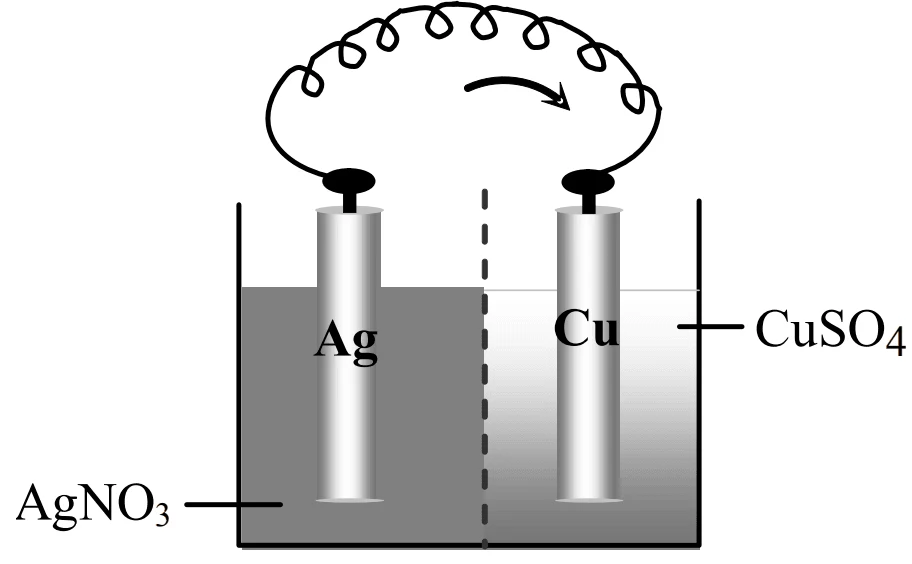
Which of the following will increase the voltage of the cell
Sn(s) + 2Ag⁺(aq) → Sn²⁺(aq) + 2Ag(s)
Three faraday of electricity is passed through molten solutions of AgNO3, NiSO4 and CrCl3 kept in three vessels using inert electrodes. The ratio in mol in which the metals Ag, Ni and Cr will be deposited is-
1:2:3
3 : 2 : 1
6 : 3 : 2
2 : 3 : 6
The molar conductances of NaCl, HCl and CH3COONa at infinite dilution are 126.45 , 426.16 and 91 ohm–1 cm2 mol–1 respectively. The molar conductance of CH3COOH at infinite dilution in ohm–1 cm2 mol–1 is
698.28
540.48
201.28
390.71
A fuel cell involves combustion of butane at 1 atm and 298 K,
C₄H₁₀ + 13/2 O₂ → 4CO₂ + 5H₂O ΔG° = −2746 kJ mol⁻¹
What is E°cell?
Zn + Cu²⁺ ⇌ Cu + Zn²⁺ , Q = [Zn²⁺]/[Cu²⁺]
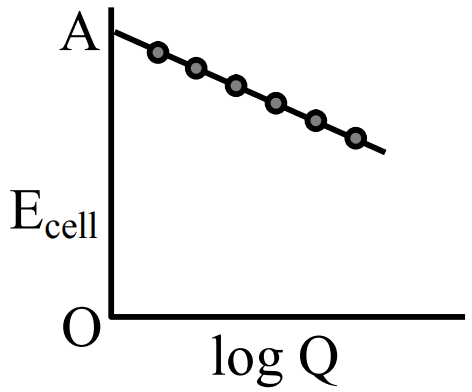
Variation of Ecell with logQ is shown. OA = 1.10 V. Ecell will be 1.1591 V when-
Standard cell voltage for the cell Pb/Pb2+ ||Sn2+/Sn is −0.01V. If the cell is to exhibit Ecell = 0, the value of [Sn2+]/[Pb2+] should be antilogs of (approx)
The number of electrons delivered at the cathode during electrolysis by a current of 1 ampere in 60 seconds is : [Charge on electron is = 1.6 × 10⁻¹⁹ C]
3.75 × 10²⁰
7.48 × 10²³
6 × 10²³
6 × 10²⁰
Which among the following transition elements has positive E°M²⁺/M value ?
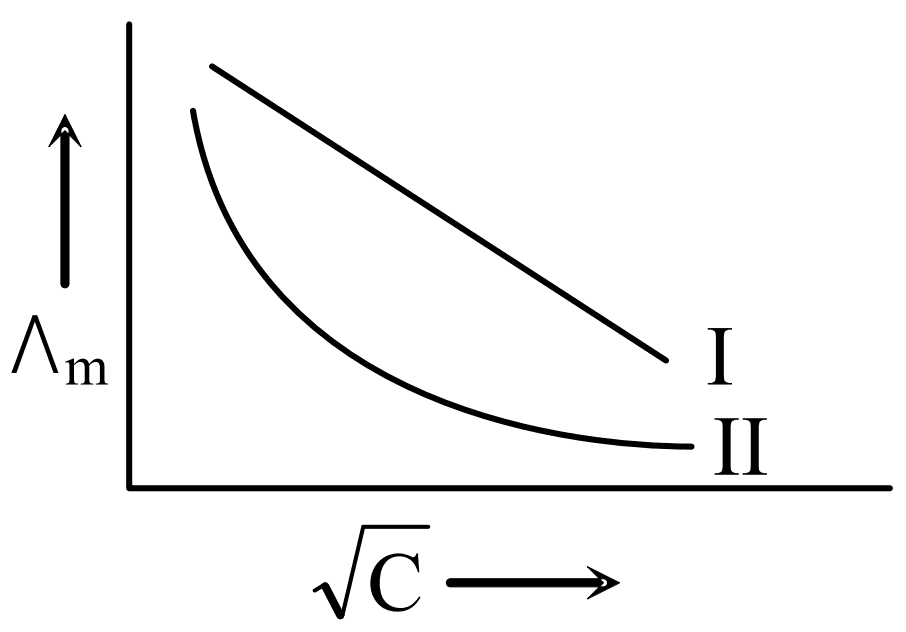
Below plot represents variation of molar conductance against √C. Select the correct option.
The following facts are available:
2A⁻ + B₂ → 2B⁻ + A₂
2C⁻ + B₂ → No reaction
2D⁻ + A₂ → 2A⁻ + D₂ Which statement is correct-
What is the % dissociation of CH3COOH, if equivalent conductivity at this dilution and at infinite dilution are 148 and 398 S cm²/mol respectively ?
Given
Ag⁺/Ag = +0.80 V
Co²⁺/Co = –0.28 V
Cu²⁺/Cu = +0.34 V
Zn²⁺/Zn = –0.76 V
The most reactive metal which displaces other metals from their salt solution is-
Consider the following half-cell reactions:
I. A + e⁻ → A⁻ E° = +0.96 V
II. B⁻ + e⁻ → B²⁻ E° = −0.12 V
III. C⁺ + e⁻ → C E° = +0.18 V
IV. D²⁺ + 2e⁻ → D E° = −1.12 V
What combination of two half-cells would result in a cell with the largest potential?
Consider the following equations for a cell reaction
A + B ⇌ C + D ; E° = x volt, Keq = K₁
2A + 2B ⇌ 2C + 2D ; E° = y volt, Keq = K₂ then :
A student made the following observations:
(i) Clean copper metal did not react with 1 M Pb(NO₃)₂ solution
(ii) Clean lead metal dissolved in 1 M AgNO₃ solution and crystals of Ag appeared
(iii) Clean silver metal did not react with 1 M Cu(NO₃)₂ solution
The order of decreasing reducing character of the three metals is-