Biotechnology and its Applications
53 questions · Click an option and press Check Answer to reveal the result
Transgenic animals are produced for which of the following purpose :
I. For study of disease
II. For obtain useful biological product
III. For vaccine test and chemical safety test
IV. For study of normal physiology and development
Choose correct option.
A gene is inserted into the PvuII site of the cloning vector (pBR322) and transformed into E.coli cells. Which one of the following statements is then true?
Thermostable DNA polymerase — Agrobacterium tumefaciens
Hind II — First restriction endonuclease
Recognition site — ori
The toxin exists as an active toxin in the Bacillus.
Match the columns-
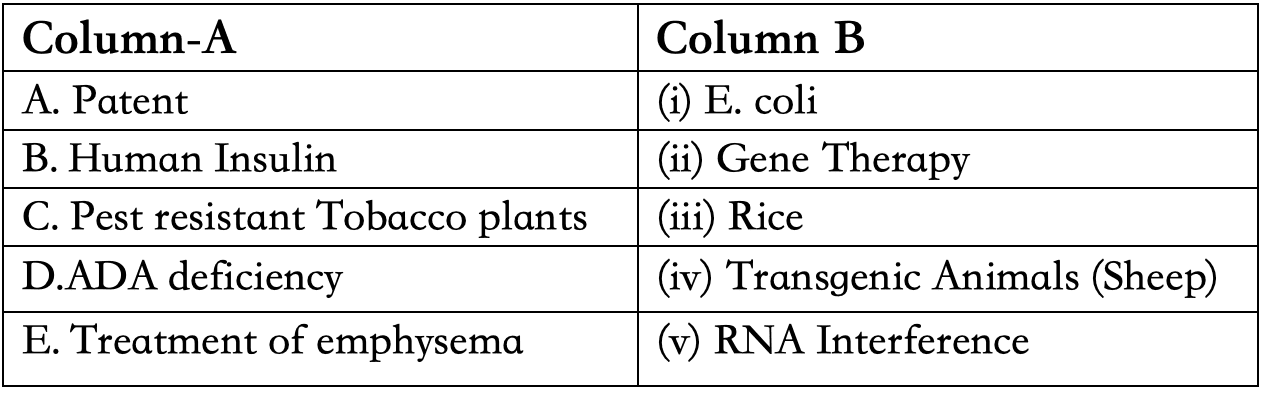
A − (iii), B − (i), C − (v), D − (ii), E − (iv)
A − (i), B − (iii), C − (iv), D − (v), E − (ii)
A − (iii), B − (iv), C − (v), D − (ii), E − (i)
A − (v), B − (ii), C − (i), D − (iii), E − (iv)
Escherichia coli
Agrobacterium tumefaciens
Salmonella typhi
Bacillus thuringiensis
Statement-I : About 30 recombinant therapeutics have been approved for human use worldwide. Statement-II : In India, 12 of these are recently being marketed. In the light of the above statements, choose the most appropriate answer from the options given below :
Statement-I : Gene therapy is use in treatment of SCID.
Statement-II : GM plants have been useful in decreasing crop yields and increase post harvest losses.
Assertion: Besides Hind II, today we know more than 900 restriction enzymes that have been isolated from over 230 strains of bacteria.
Reason: EcoRI cuts staggered ends, at particular restriction sites
How many of the following are the applications of transgenic animals?
To understand Normal physiology and development, Study of disease, To obtain Biological products, To test safety of Vaccine, Chemical safety testing, Molecular diagnosis.
Match column I containing transgenic organism with their specific characteristics in column-II and select the correct answer ? 
Read the given statements and select the correct option.
Statement I : In insertional inactivation, blue colour produced by bacterial colonies indicates that the plasmid does not have an insert into the bacterial genome.
Statement II: Presence of insert results into insertional inactivation of β-galactosidase enzyme and the colonies do not produce any colour.
Match the column :
I Recombinant DNA technology — A Vector
II Extrachromosomal element — B Sealing enzyme
III Macromolecular separation — C Gel electrophoresis
IV DNA ligase — D Genetic engineering
α-1-antitrypsin" is used to treat Rheumatoid arthritis.