Anatomy of Flowering Plants
50 questions · Click an option and press Check Answer to reveal the result
Select the correct combination of the statements regarding the characteristics of middle lamella
a. It holds the different neighbouring cells together.
b. It is composed of Mg pectate only.
c. It gets dissolved during ripening of fruits.
I. Peripheral vascular bundles are smaller than the centrally located vascular bundles.
II. Phloem parenchyma is absent.
III. Water containing cavities are present within the vascular bundles. Which of the above characters belongs to the monocotyledonous stem?
Which statement are correct about guard cells?
I. They are modified ground tissues.
II. They are chlorophyllous.
III. Its outer wall is thin and inner wall is highly thickened.
IV. They regulate stomatal movement for transpiration and gaseous exchange.
Read the following statements about the stem and identify them as true (T) or false (F).
(A) It is the ascending part of plant axis.
(B) It develops from radicle of the embryo of a germinating seed.
(C) Stems are generally green when older but brown when young.
(D) It may perform function of vegetative propagation.
Match the following Columns.
| Column I | Column II |
|---|---|
ABulliform cells | iStomata |
BGuard cells | iiEndodermis |
CCasparian bands | iiiAccessory cells |
DSubsidiary cell | ivIsobilateral leaf |
Select the correct statement from the following.
How many of the following statements about the anatomy of a dicot stem are correct?
A. The vascular bundles are arranged in a ring.
B. The primary xylem has exarch protoxylem.
C. The outermost layer is the epidermis, which may bear trichomes.
D. The cortex is differentiated into hypodermis, cortical layers, and endodermis.
E. The central portion of the stem is occupied by a large, conspicuous pith.
Choose the correct option.
Choose the correct option for identification of A to E in the given diagram of a portion of TS of dicot stem
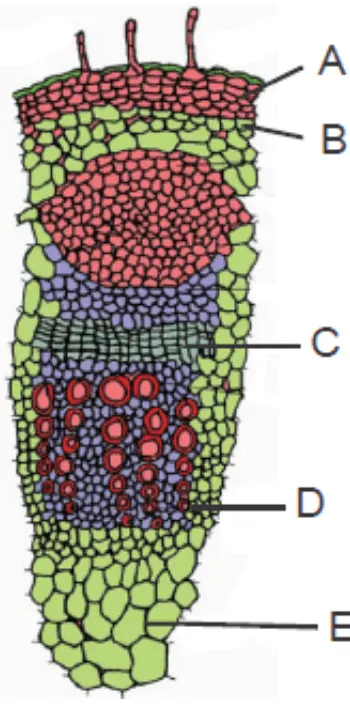
A–Collenchyma, B–Sclerenchyma, C– Cambium, D–protoxylem, E–Pith
A–Sclerenchyma, B–Collenchyma, C– Cambium, D–Protoxylem, E–Pith
A–Parenchyma, B–Collenchyma, C– Cambium, D–Protoxylem, E–Pith
A–Collenchyma, B–Parenchyma, C– Cambium, D–Protoxylem, E–Pith
Monocot leaves